
How our community works
Passages is a self-directed learning community. Young people have a lot of freedom here, but that freedom exists within a community of other people.
Self-direction means having meaningful choice over your own life, learning, time, interests, and participation. It doesn't mean having freedom over other people, or freedom from the agreements and responsibilities that come with being part of a community.
We don't separate life and learning very much at Passages. Figuring out what matters to you, advocating for yourself, navigating conflict, setting boundaries, taking responsibility when you've affected someone, or challenging something you think is unfair are all part of the learning too.
The conditions we try to create
We aren't trying to produce one particular kind of learner or one definition of success. We are trying to create the conditions where young people can figure out who they are, what matters to them, and how they want to move through the world.
We want Passages to be a place where young people can:
Be themselves without having to earn belonging
Different ways of communicating, learning, participating, regulating, and connecting are expected here. Young people shouldn't have to become easier, quieter, more productive, or more typical in order to belong.
Have real ownership over their lives and learning
Young people have meaningful choices about how they spend their time, what they pursue, what support they want, and what learning looks like for them.
Discover what matters to them
There isn't one path everyone needs to follow. Young people have time, space, resources, relationships, and opportunities to explore interests, try things, change direction, get deeply into something, or not know yet.
Have a voice that actually matters
Young people aren't just consulted about their community. They have real authority to shape it, question it, challenge rules, propose changes, and participate in decisions.
Experience freedom alongside responsibility
Autonomy doesn't mean living without other people. Young people have freedom while also learning to consider boundaries, impact, shared spaces, agreements, and the needs of the people around them.
Make mistakes without those mistakes defining them
Conflict, poor choices, disagreement, and dysregulation are part of being human. Accountability helps young people understand what happened, take responsibility where needed, and figure out what comes next.
Build trust in themselves
Ultimately, we want young people to leave Passages knowing themselves better and trusting that they can learn, make decisions, ask for help, change direction, navigate uncertainty, and build a life that is their own.
What this means in practice
Self-direction doesn't mean anything goes. Being part of Passages means sharing a community with people who may have very different needs, boundaries, interests, and ways of being. There are shared spaces to care for, agreements to follow, other people's boundaries to respect, and responsibilities that come with being part of the community.
Individual needs matter and may change what participation or responsibility looks like for someone. The goal isn't for everyone to behave the same way. It's figuring out how different people can share a community together.
Young people have a real say
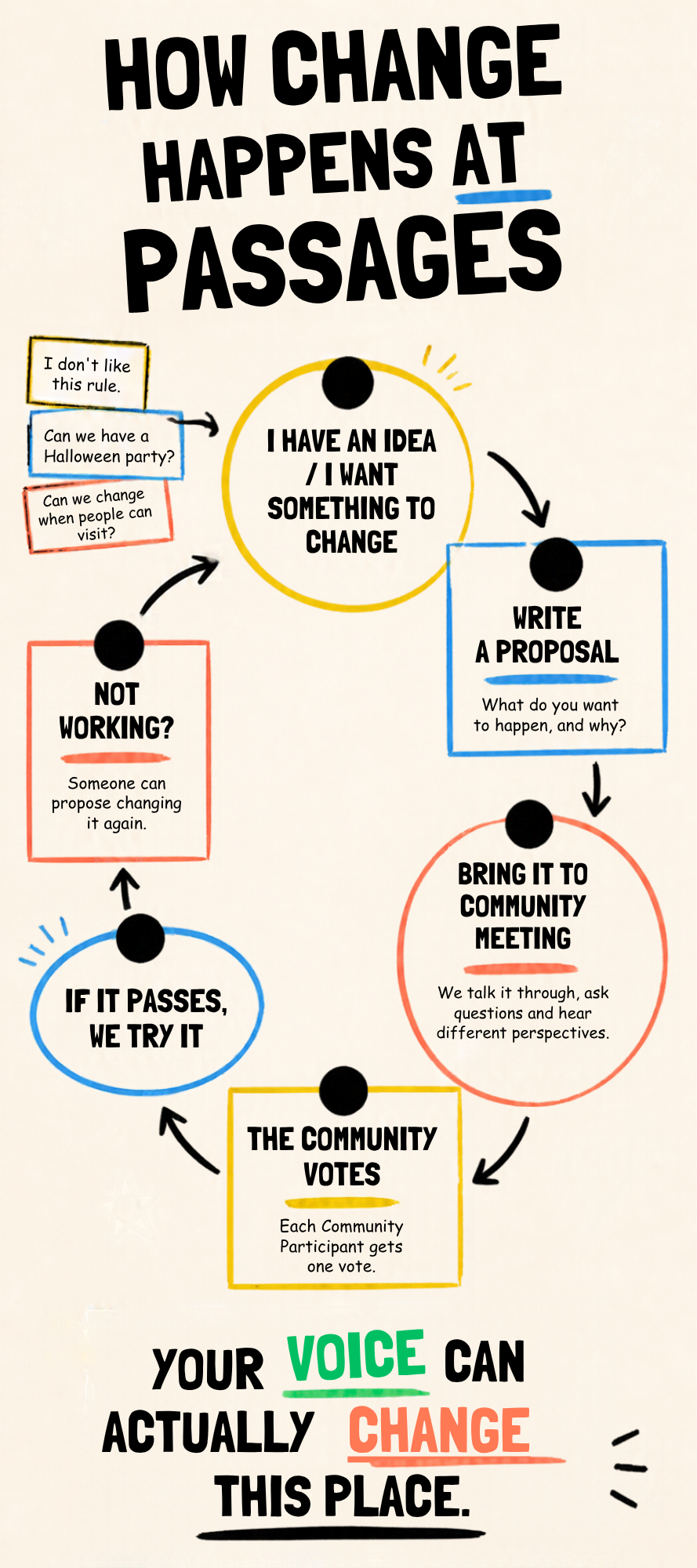
Passages is democratically run in many areas of community life. Learners, staff, and interns can raise concerns, propose changes, participate in committees, change community rules, and vote on decisions. Within community governance, adults don't get more votes because we're adults.
We have a Rule Book that has been built by the Passages community over many years, and each new group of learners continues to shape it. If someone thinks a rule is unfair, wants to change how something works, or simply has an idea for something new, they can bring a proposal to the community.
Young people don't have to simply accept, "That's the rule." They do need to follow community agreements while they're in place, but they also have real power to question them and use the democratic process to change them.
When things go wrong
Conflict happens here. People make mistakes, cross boundaries, disagree, get dysregulated, and sometimes hurt someone’s feelings. For everyday Rule Book issues, we use a learner-led Rules Committee process to understand what happened and decide what accountability may be needed.
Learners consider what happened, its impact, the circumstances around it, whether there is a pattern, and what is needed moving forward. Responses aren't always identical because age, development, disability, circumstances, and previous attempts to address an issue all matter.
More serious situations are handled by staff, usually more privately, with a focus on safety, fairness, accountability, and repair where possible.
Democracy has boundaries
Young people have meaningful authority at Passages, but they aren't responsible for running the organization. Some responsibilities have to remain with Passages and the adults responsible for it. These include things like safety and safeguarding, serious incidents, human rights, privacy, enrolment, staffing, finances, and legal responsibilities. When something falls within those responsibilities, staff may need to step in or make a decision rather than putting it to a community vote.
Parents and caregivers are important partners in a young person's experience at Passages too, but they aren't members of learner governance and don't vote in Community Meeting or Rules Committee.
The goal at Passages isn't a community without adults, rules, boundaries, or responsibility. It's a community where young people experience real autonomy within a real community, and learn that freedom and responsibility go together.